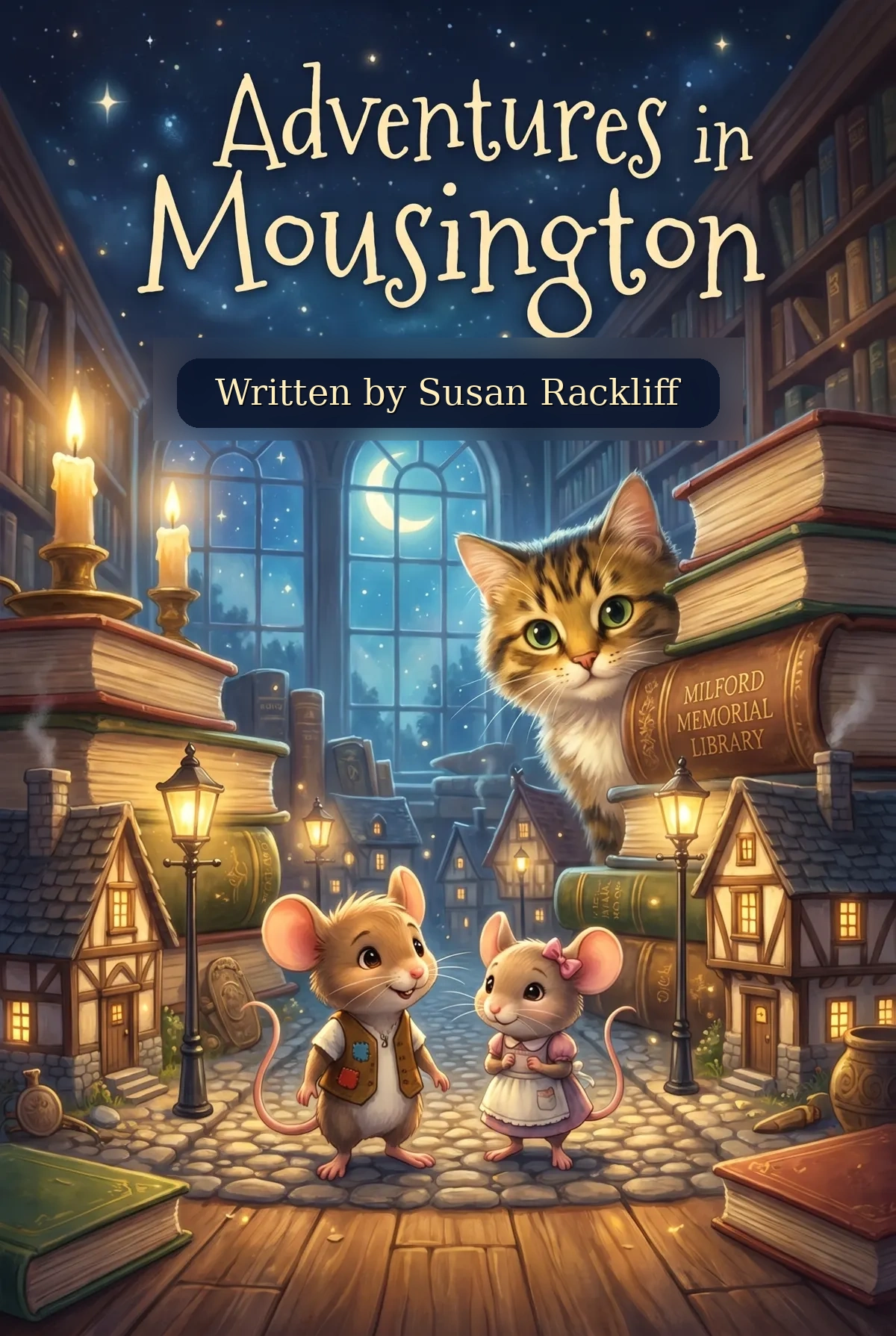
A picture book
Adventures in Mousington
"Mice find adventure and friendship in the most unexpected places."
The Storybook
Open the book for a full-page read. Swipe, tap the arrows, or use your keyboard's ← → keys.
Publisher pitch
A cozy underground adventure about
courage, kindness, and the magic of stories.
Beneath Milford Memorial Library is Mousington — a candle-lit town where two little mice, Buddy and Lizzy, set out for the adventure of their lives. They learn that the toughest hearts are often the loneliest, that real bravery is kindness, and that the very best adventures live inside a book.
- Author
- S.P. Rackliff
- Age range
- 4–8 (read-aloud), 7–9 (independent)
- Format
- 15 illustrated pages
- Themes
- Courage · Kindness · Friendship · Imagination · Books
- Comparable titles
- The Tale of Despereaux · Mrs. Brisby · Town Mouse, Country Mouse
For parents & teachers
A reading guide for courage, kindness, and story-powered imagination.
Use this section as a parent note, classroom discussion starter, or publisher-facing education hook. The app is designed to support read-aloud, read-with-me, independent reading, hearing-impaired, visually impaired, dyslexia-friendly, and calm sensory experiences.
-
01
What made Lizzy brave?
Was it being big and loud — or was it standing still and saying "no"? Talk about a time you stood up for yourself or a friend.
-
02
Why did Ice act tough?
What was Ice really feeling under the leather jacket and the blue hair? Have you ever pretended to feel one thing when you felt another?
-
03
How did Furball show kindness?
Furball was big and the mice were small. What did he do with his bigness? What can we do with the bigness we have?
-
04
How can books take us on adventures?
Great Grampy never left Mousington. Where have you been because of a book? Make a tiny list together.
-
05
When did someone get a second chance?
Ice frightened the mice — and was still welcomed at dinner. What does it feel like to forgive? What does it feel like to be forgiven?
-
06
Who is your "Great Grampy"?
Whose stories do you love to hear again and again? Call or visit them this week and ask for one — then draw it together.
Meet the characters — a social-emotional map
Each friend in Mousington carries one big feeling. Point to a page, name the feeling, and let your child finish the sentence "I felt like that when…"
Buddy · Bravery
Brave doesn't mean unafraid.
Buddy steps toward the storm and the flood (pages 7–10). Brave is doing the scared thing anyway, for someone you love. Ask: "What's a brave, small thing you could do tomorrow?"
Lizzy · Kindness & courage
The quiet, mighty "no."
Lizzy stands still and says "no" to a bully (pages 5–6). Kindness and courage are the same muscle. Practice a calm, strong "no" voice together — shoulders down, eyes up.
Ice · Loneliness & repair
Mean is sometimes lonely in disguise.
Ice acts tough because no one has ever told him "no — but come sit with us." Talk about how hurt feelings can look like anger, and how the mice offered repair instead of revenge.
Furball · The gentle helper
Big strength, soft hands.
Furball could frighten everyone but chooses to protect and warn (pages 8–9). Ask: "What is your bigness — your loud voice, fast legs, big ideas — and how can it help someone smaller?"
Scratch / Herman · Belonging
A new name, a new friend.
On page 11 the mice giggle and welcome Herman — "Great Grampy's name too" — and he feels accepted. Talk about how it feels to be the new one, and one way to welcome someone this week.
Great Grampy · Imagination
Adventures lived through books.
The final twist (pages 13–14): Great Grampy never left Mousington — he travelled through stories. Intergenerational storytelling is the heartbeat of the book. Whose voice do you hear when you read?
Living-room activities
Three reading modes
Read to Me · Read With Me · I'll Read
Begin with the built-in read-aloud controls for bedtime. Use “Read With Me” by pausing after each page title and inviting the child to echo a favorite line. For independent readers, turn captions on and ask them to describe the picture before reading the text.
Bedtime ritual
One feeling, one page.
Pick a single page tonight. Read it, name the feeling, and share "a rose and a thorn" from your day that matches it. Calm, short, repeatable.
Act it out
The brave "no" game.
Take turns being Lizzy. One person gently "asks for the bag," the other practices a calm, firm "no." Cheer every strong, kind voice.
Grandparent call
Collect a Great Grampy story.
Call a grandparent or elder and ask for one true adventure from when they were small. Draw it and tuck it inside the book as a bookmark.
Classroom activities
Classroom activity
Map Mousington together.
Draw the library above and the town below. Add pebble streets, candle lamps, Ice's alley, Furball's tunnel, and Great Grampy's room.
Circle time
The empathy chair.
One child sits as "Ice." Classmates offer kind sentences that might help a lonely friend feel welcome. Rotate so everyone gives and receives.
Writing center
Rewrite the bully scene.
Older students rewrite pages 5–6 from Ice's point of view. What is he thinking? Where did his toughness come from? Share and discuss.
Vocabulary & read-along
Watch the words light up.
Turn on read-aloud and let the word-by-word glow model fluent phrasing. Pause on new words (cobblestones, current, accepted) and build a Mousington word wall.
Printable-style activities
No printer needed — do these on paper, a whiteboard, or a tablet drawing app.
- Feelings thermometer. Draw a thermometer and place each character where their feeling sits — from calm (Furball) to boiling (Ice) — then talk about how Ice cools down by the end.
- Kindness coupon book. Fold paper into four coupons. Each one is a small, brave, kind act to "spend" this week (say a strong "no," welcome someone new, help someone smaller).
- My Mousington map. Give each child a blank page to invent their own under-the-floorboards room and one friend who lives there — with a feeling and a name.
- Second-chance comic. Three boxes: the mistake, the feeling, the repair. Retell how Ice went from the alley to the dinner table.
- Great Grampy interview. Five questions to ask an elder, with room to draw their answer. Bring it back and share.
SEL focus
Kindness is the bravest choice.
Lizzy's “no,” Ice's honesty, and Furball's gentleness create a simple emotional-literacy arc children can act out and retell.
How families use it
Bedtime, car rides, quiet corners.
Read-to-me for wind-down, read-with-me for reluctant readers, and the calm sensory mode for big-feelings days. One page is enough.
How classrooms use it
Morning meeting to library center.
A five-minute SEL opener, a small-group read-along station, or a whole-class empathy lesson anchored to Ice's repair and Herman's welcome.
Accessibility note
Every child gets a way in.
Use scene descriptions for visually impaired readers, sound captions for hearing-impaired readers, and the dyslexia-friendly mode for wider spacing.
5-years-ahead roadmap
The Living Storybook vision.
Next layers can add empathic narration, sign-language picture-in-picture, tactile illustration exports, AR Mousington maps, ethical co-author micro-stories, and teacher dashboards for school adoption.
From the author's notebook
The original manuscript pages
These photographed pages are the source for this adaptation. S.P. Rackliff's hand-written draft, kept just as it was found.
Tap any page to expand it into a readable view.